After the Declaration of Independence was signed in 1776, many Georgetown community members led campaigns to help with the forthcoming war. They raised money, provided arms, and recruited soldiers. No significant battles occurred near Georgetown during the American Revolution; its citizens contributed to the war effort as a part of the state of Maryland.1
During the Revolution
As a part of Maryland, Georgetown sent its young men to the battlefield to fight for American independence. The men from Maryland soon earned a reputation as strong fighters. In the Battle of Brooklyn, the first battle after America declared independence, the British surrounded the Continental Army in New York City. As the fledgling forces were outnumbered and outmatched, General George Washington ordered their retreat. The Pennsylvania, Delaware and Maryland infantry were tasked with holding off the British to allow the army time and cover to retreat. When the Pennsylvania and Delaware lines collapsed, Maryland’s was the only one left protecting the retreating Continental forces. With great sacrifice, losing 256 of their 270, the Maryland 400 held off the British long enough for the Continental Army to live to fight another day. Watching their actions nearby, General George Washington gave the group their nickname of “Old Line.”2
As one of two major ports in the state, the other being Baltimore, Georgetown was tasked with accumulating and shipping supplies provided by the state to the Continental Army. In 1780, General Washington sent one of many circulars to the States calling “for specific quantities of provision—Rum & Forage for the Army, and directing the Articles of supplies to be collected & deposited at such places in each of the States, as should be judged most convenient by me.”3 In this letter, Washington customized the amount requested for each state and indicated the port to which he wanted the supplies directed. For Maryland:
“GW requested 14,000 barrels of flour at Head of Elk and 3,000 barrels each at Baltimore and Georgetown, for a total of 20,000 barrels. He also desired 140 tons of hay at Head of Elk and 30 tons each at Baltimore and Georgetown, for a total of 200 tons. Finally, GW wanted 52,152 bushels of corn at Head of Elk and 2,000 bushels each at Baltimore and Georgetown, for a total of 56,152 bushels.”4
During the Revolutionary War, Georgetown continued to grow. It had a small manufacturing boom to assist the war effort by making arms and other goods; these arms and manufactured goods sparked Georgetown’s industrial heritage.5 In 1776 the first post office in the town opened and was run by postmaster Benjamin Franklin.6
Some of the harshest American winters were recorded during the Revolutionary War, specifically in 1778 and 1779. In 1777-1778, this was the winter when the Continental Army encamped at Valley Forge, and 1,000-2,000 men died due to disease, thought to be exacerbated by lack of food and wet conditions.7 The next year,1778-1779, the winter was even more frigid. In Georgetown, the Potomac and Chesapeake Bay iced over to the point that all shipping was forced to cease.8 Horse drawn carriages used the Potomac as a roadway during the winter freeze.9
Post-Revolution Expansion
In the 1780s, Georgetown continued its upward momentum with major land expansions. In 1783, the year the Revolution ended, Georgetown doubled its footprint with a 60-acre tract, called Beall’s Addition.10 Two years later, the town grew by another 20 acres with the tract called Peter, Beatty, Threlkeld, and Deakin’s Addition. Finally, in 1789 more acreage was added with Beall’s Second Addition.11
As the town’s footprint grew, so did its population, as well as its need for greater infrastructure. In 1788, a bridge was built to provide safe passage over Rock Creek and connect Georgetown to the land east of its borders, which would later become the Capital City. The bridge is on the site of the current M Street bridge, which used to be known as Bridge Street.12
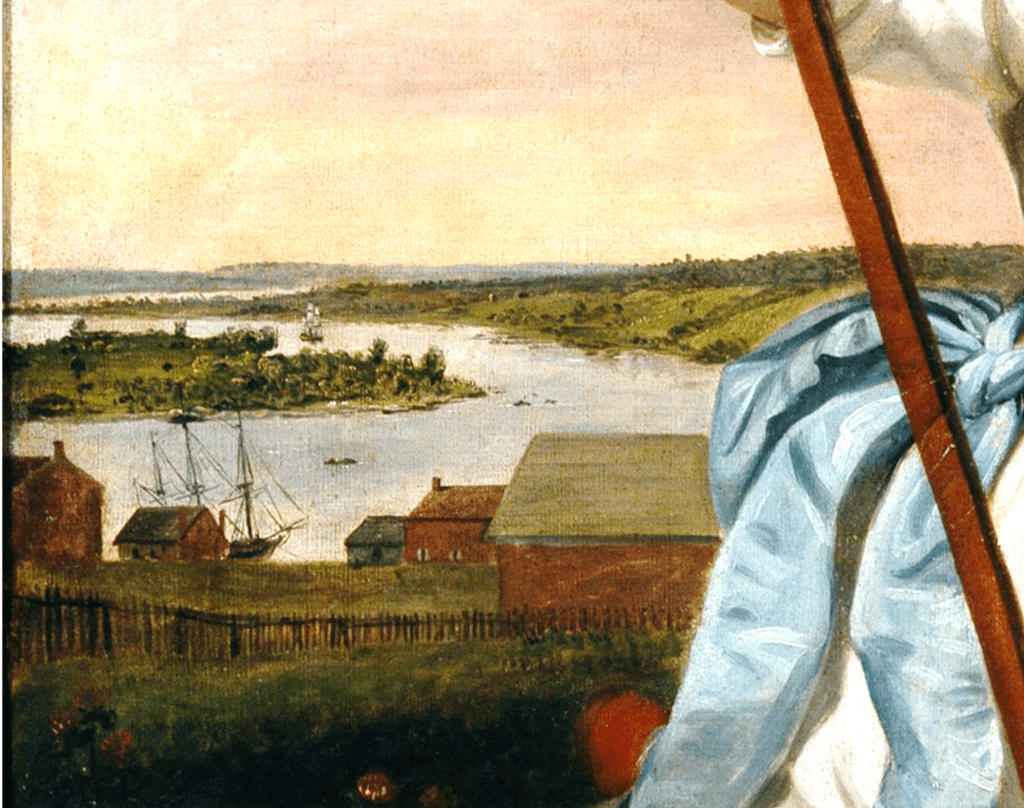
Moving on from the war in 1783, Georgetown continued its industrial growth, adding dozens of new businesses along the waterfront.13 Thomas Corcoran opened his leather works in 1788, which evolved into an economic dynasty that would place the Corcorans as one of the wealthiest families in America.14 By 1789, the Georgetown waterfront was littered with textile mills, paper factories, and flour mills.15
To help facilitate trade from the interior of Maryland to Georgetown, the Potomac Company, under the leadership of George Washington and others, was chartered in 1785 by both the Virginia and Maryland legislatures. About four miles upriver from Georgetown, a ten-mile stretch of rapids, known as Little Falls, marks the end of the tidal Potomac River; the goal of the Potomac Company was to create a canal and channel to ease commerce between the east and the west by navigating around these falls.16 These rapids made any commerce beyond them impossible via the river. The Company built locks and canals connecting Georgetown with the upstream area around Harpers Ferry.17 The Potomac Company’s work allowed for easier transportation of goods like flour, pork, beef, and tobacco, between interior Maryland and the port of Georgetown, which in turn increased trade.18 In the 1820s, the canal and lock system of the Potomac Company was taken over by the Chesapeake and Ohio Company.19
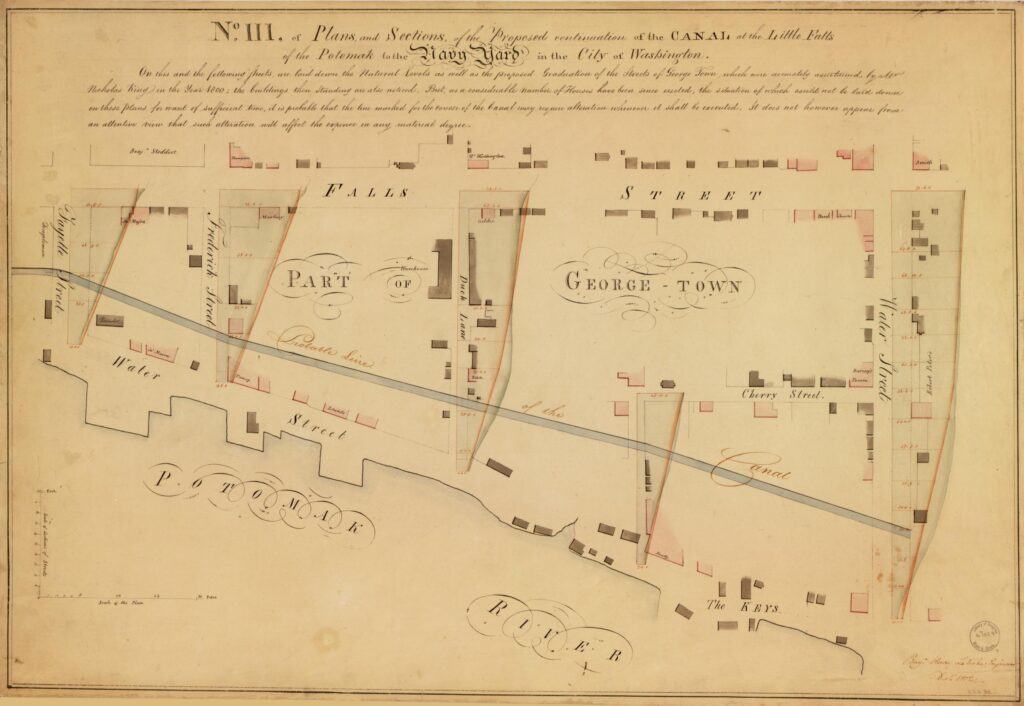
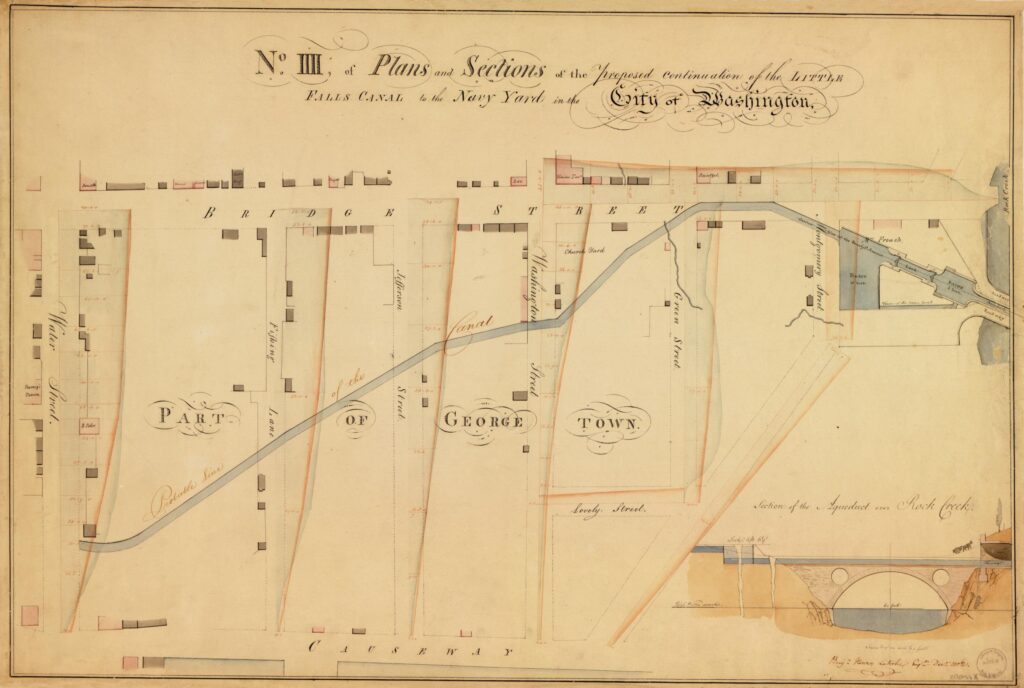
Plans and sections of the proposed continuation of the Washington Canal from Rock Creek to Little Falls of the Potomac, Washington D.C. http://hdl.loc.gov/loc.gmd/g3852wm.gct00208
The wealth of Georgetowners and the town itself was fueled by enslaved labor. The port of Georgetown continued to participate in the slave trade during and after the fight for independence. In 1776, Blacks made up one third of Georgetown’s population.20 By 1800, the town had 1,449 enslaved and 277 free Blacks in a total population of 5,120.21 Urban slavery, which took place in towns like Georgetown, differed from rural or plantation slavery. For those enslaved in urban environments, there was more proximity to their enslavers. On plantations, many enslaved would work in fields with overseers and return to their homes at night. Due to the lack of space in urban environments, an enslaved person would be in the same building as their enslaver, and sometimes even sleeping in the same room at night. In urban environments, the enslaved could ’hire out’ their time to others, performing skilled labor for wages away from the enslaver’s property.22 Often these wages would go to the master for their work, but in some cases some of the money earned was kept by the enslaved.23 These meager earnings could be saved and used to purchase their freedom.24 Many construction sites around Georgetown utilized rented enslaved labor for their projects, including the channels and canals built by the Potomac Company.25
Those who were able to purchase their freedom could continue to live and work in Georgetown as a member of the Free Black community. These individuals were descendants of indentured servants, free immigrants, those born to free parents, those whose relatives bought their freedom, those who bought their freedom, those who were freed by actions of their enslaver, and those who had successfully escaped bondage by posing as free.26
Ratification of the Constitution and the New Nation
In 1787, Maryland sent five delegates to the Constitutional Convention in Philadelphia, Pennsylvania. After the first five delegates refused the appointment, five more were chosen. Maryland sent Luther Martin, James McHenry, Daniel Jenifer of St. Thomas, Daniel Carroll, and John Francis Mercer. Though none of these delegates were from Montgomery County or Georgetown, two delegates, Daniel Carroll and John Francis Mercer, were from Anne Arundel County, Maryland, east of the current capital city.27
As a small state, Maryland supported equal representation in the Senate, and the delegation eventually supported the Great Compromise which called for equal representation in the Senate and representation based on population in the House.28
After the convention, the Maryland Legislature called for a ratifying convention in the state and an election for convention delegates. Approximately 10,000 Marylanders cast ballots electing delegates, the vast majority in favor of ratification. At the ratification convention, 65 members supported the Constitution (Federalists) and 12 did not (Anti-Federalists). On April 28, 1789, Maryland ratified the Constitution, becoming the seventh state to do so.29
With the new government, 1789 was a big year for Georgetown and the fledgling nation. Higher education came to Georgetown in 1789 with the founding of Georgetown College by Roman Catholic Clergymen.30 The town was also incorporated by a Maryland charter this year, providing the town with the ability to elect a local government.31 Finally, in April of 1789, one year after the state ratified the new Constitution, George Washington passed through Georgetown on his way to Philadelphia to accept his elected post as the First President of the United States.32
Written by Education and Programs Manager, Caroline Eisenhuth
April 2026
Notes:
- David Mould, and Missy Lowe, Remembering Georgetown: A History of the Lost Port City (The History Press, 2009). ↩︎
- Redding, Nicholas A. “The Origin of the ‘Old Line State’.” Preservation Maryland, August 27, 2021. https://preservationmaryland.org/the-origin-of-the-old-line-state/ ↩︎
- “Circular to the States, 26 March 1780,” Founders Online, National Archives, https://founders.archives.gov/documents/Washington/03-25-02-0112. [Original source: The Papers of George Washington, Revolutionary War Series, vol. 25, 10 March–12 May 1780, ed. William M. Ferraro. Charlottesville: University of Virginia Press, 2017, pp. 153–158.] ↩︎
- “Circular to the States, 26 March 1780,” Founders Online, National Archives, https://founders.archives.gov/documents/Washington/03-25-02-0112.
Head of Elk is the historic name for Elkton, a town north of Baltimore on the Elk River that leads into the Chesapeake Bay. George Washington designated supplies to be held there as it is a northern post on the Chesapeake Bay, and is between Baltimore and the Revolutionary Capital, Philadelphia, Pennsylvania. ↩︎ - DC Historic Sites, “Early and Industrial Georgetown,” DC Preservation League Walking Tour, Accessed April 1, 2026, https://historicsites.dcpreservation.org/tours/show/10 ↩︎
- Mould, and Lowe, Remembering Georgetown ↩︎
- Mary Stockwell, “Valley Forge.” The George Washington Presidential Library, Center for Digital History Digital Encyclopedia, Accessed April 1, 2026, https://www.mountvernon.org/library/digitalhistory/digital-encyclopedia/article/valley-forge ; Mould, and Lowe, Remembering Georgetown ↩︎
- Mould, and Lowe, Remembering Georgetown ↩︎
- Mould, and Lowe, Remembering Georgetown ↩︎
- Mould, and Lowe, Remembering Georgetown ↩︎
- Mould, and Lowe, Remembering Georgetown ↩︎
- Mould, and Lowe, Remembering Georgetown ↩︎
- Mould, and Lowe, Remembering Georgetown ↩︎
- Mould, and Lowe, Remembering Georgetown ↩︎
- DC Historic Sites. “Early and Industrial Georgetown.” ↩︎
- National Park Service. “Little Falls Branch.” Accessed April 1. 2026. https://www.nps.gov/places/000/little-falls-branch.htm ; George Washington’s Mount Vernon. “The Potomac Company.” Accessed April 1, 2026. https://www.mountvernon.org/george-washington/the-potomac-company ↩︎
- Zoie Horecny, “The Potomac Company,” The George Washington Presidential Library, Center for Digital History Digital Encyclopedia, March 11, 2025, https://www.mountvernon.org/library/digitalhistory/digital-encyclopedia/article/the-potomac-company#5 ↩︎
- Zoie Horecny, “The Potomac Company,” Center for Digital History Digital Encyclopedia. ↩︎
- Zoie Horecny, “The Potomac Company,” Center for Digital History Digital Encyclopedia. ↩︎
- Kathleen Menzie Lesko, Valerie M. Dabb, and Carroll R. Gibbs, “The Early Years: 1740-1900,” In Black Georgetown Remembered: A History of Its Black Community from the Founding of the “Town of George” in 1715 to the Present Day (Georgetown, 2021) ↩︎
- Lesko, Dabb, and Gibbs, “The Early Years: 1740-1900,” In Black Georgetown Remembered. ↩︎
- Lesko, Dabb, and Gibbs, “The Early Years: 1740-1900,” In Black Georgetown Remembered. ↩︎
- Lesko, Dabb, and Gibbs, “The Early Years: 1740-1900,” In Black Georgetown Remembered. ↩︎
- Lesko, Dabb, and Gibbs, “The Early Years: 1740-1900,” In Black Georgetown Remembered. ↩︎
- Zoie Horecny, “The Potomac Company,” Center for Digital History Digital Encyclopedia. ↩︎
- Lesko, Dabb, and Gibbs, “The Early Years: 1740-1900,” In Black Georgetown Remembered. ↩︎
- EBSCO, “Maryland Ratifies the Constitution,” 2022, https://www.ebsco.com/research-starters/politics-and-government/maryland-ratifies-constitution ; The Maryland State House, “Five Delegates to Philadelphia,” Accessed April 1, 2026, https://msa.maryland.gov/msa/mdstatehouse/html/philadelphia.html ↩︎
- EBSCO, “Maryland Ratifies the Constitution,” 2022. ; The Maryland State House, “Five Delegates to Philadelphia,” Accessed April 1, 2026. ↩︎
- EBSCO, “Maryland Ratifies the Constitution,” 2022. ; The Maryland State House, “Five Delegates to Philadelphia,” Accessed April 1, 2026. ↩︎
- Mould, and Lowe, Remembering Georgetown ↩︎
- “Georgetown Historic District: One of DC’s oldest neighborhoods, Georgetown Historic District encompasses a complete historic town, and was the District’s first designated historic district.,” DC Historic Sites, accessed April 1, 2026. https://historicsites.dcpreservation.org/items/show/240. ↩︎
- Mould, and Lowe, Remembering Georgetown ↩︎
Bibliography:
“Circular to the States, 26 March 1780,” Founders Online, National Archives, https://founders.archives.gov/documents/Washington/03-25-02-0112. [Original source: The Papers of George Washington, Revolutionary War Series, vol. 25, 10 March–12 May 1780, ed. William M. Ferraro. Charlottesville: University of Virginia Press, 2017, pp. 153–158.]
DC Historic Sites. “Early and Industrial Georgetown.” DC Preservation League Walking Tour. Accessed April 1, 2026. https://historicsites.dcpreservation.org/tours/show/10
EBSCO. “Maryland Ratifies the Constitution.” 2022. https://www.ebsco.com/research-starters/politics-and-government/maryland-ratifies-constitution
“Georgetown Historic District: One of DC’s oldest neighborhoods, Georgetown Historic District encompasses a complete historic town, and was the District’s first designated historic district.,” DC Historic Sites, accessed April 1, 2026. https://historicsites.dcpreservation.org/items/show/240.
George Washington’s Mount Vernon. “The Potomac Company.” Accessed April 1, 2026. https://www.mountvernon.org/george-washington/the-potomac-company
Horecny, Zoie. “The Potomac Company.” The George Washington Presidential Library, Center for Digital History Digital Encyclopedia. March 11, 2025. https://www.mountvernon.org/library/digitalhistory/digital-encyclopedia/article/the-potomac-company#5
Lesko, Kathleen Menzie, Valerie M. Dabb, and Carroll R. Gibbs. “The Early Years: 1740-1900.” In Black Georgetown Remembered: A History of Its Black Community from the Founding of the “Town of George” in 1715 to the Present Day. 30th Anniversary Edition. Georgetown University Press, 2021.
Mould, David, and Missy Lowe. Remembering Georgetown: A History of the Lost Port City. The History Press, American Chronicles, 2009.
National Park Service. “Little Falls Branch.” Accessed April 1. 2026. https://www.nps.gov/places/000/little-falls-branch.htm
Redding, Nicholas A. “The Origin of the ‘Old Line State’.” Preservation Maryland, August 27, 2021. https://preservationmaryland.org/the-origin-of-the-old-line-state/
Stockwell, Mary. “Valley Forge.” The George Washington Presidential Library, Center for Digital History Digital Encyclopedia. Accessed April 1, 2026. https://www.mountvernon.org/library/digitalhistory/digital-encyclopedia/article/valley-forge
The Maryland State House. “Five Delegates to Philadelphia.” Accessed April 1, 2026. https://msa.maryland.gov/msa/mdstatehouse/html/philadelphia.html