Upon the conclusion of the Revolutionary War in 1789, the newly founded American government began to ponder the location of the future capital. Various locations had been under consideration in the last decade: the banks of the Delaware and Potomac Rivers, as well as Philadelphia and New York, had all been put forth as potential sites.
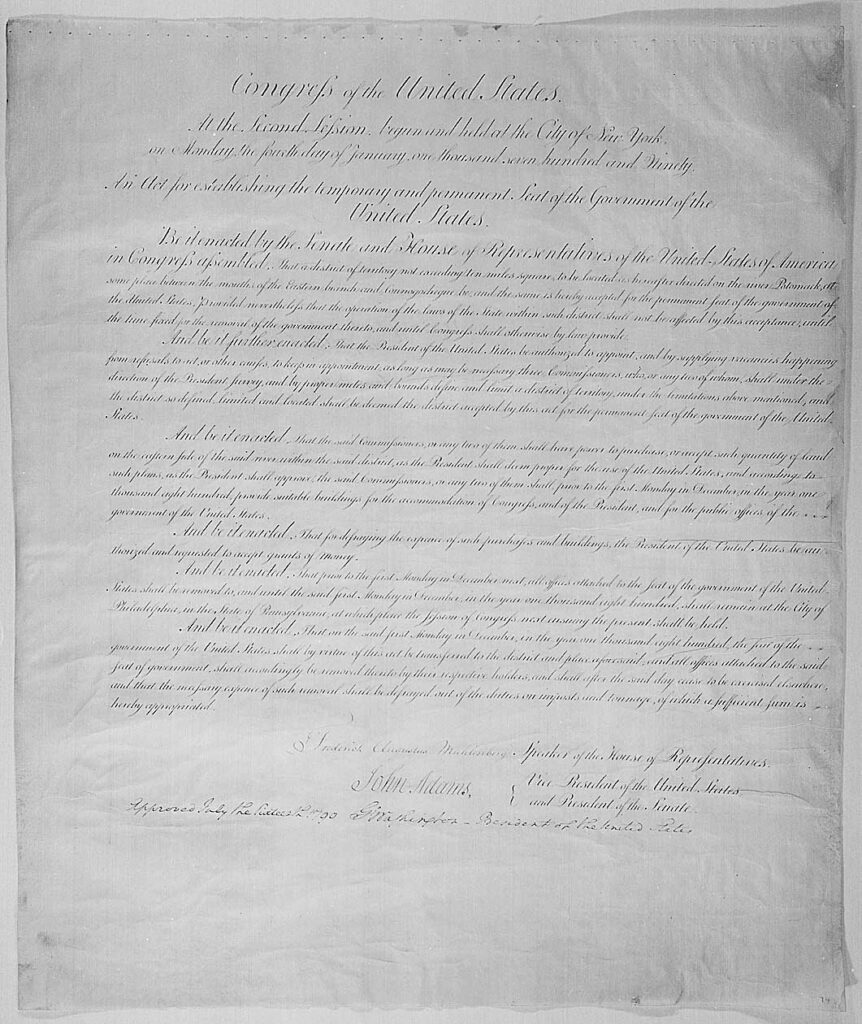
The capital’s location was a hotly debated one, with repeated motions to designate a location failing to pass in the Senate. Ultimately, in exchange for the Federal assumption of state debts following the Revolutionary War, the Compromise of 1790 designated “a site on the Potomac” as part of the Residence Act of 1790 , signed on July 16, 1790 by George Washington. There were several advantages to “a site on the Potomac”: its position as the furthest inland port, with access to deepwater ports across the river in Virginia, gave it the ability to participate in international trade and diplomacy, while still benefiting from inland protection. Additionally, its proximity to founders’ homes like Monticello, Montpellier, and Mount Vernon made it a relatively easy “commute” for early members of the Federal government.
The planned capital’s legal status would be that of neither a city nor a state, but a federal district governed by Congress. Rather than build the new capital around a preexisting site, the founders chose to build a city from the ground up. This was in part a symbolic choice, as courts and capitals had historically been moved between large cities instead of being planned in one place.
The District’s position as a planned city meant, of course, that it would need an architect. That architect came in the form of Pierre Charles L’Enfant, a French artist and military engineer who had been recruited to serve in the American Revolution in 1777, when he was 23. Despite being a relatively low-ranking member of the French military, his charisma won him the friendship and recognition of several key Americans, including George Washington. When an architect was sought out for the planned capital, Washington commissioned L’Enfant, whose detailed plans flew in the face of Thomas Jefferson’s plans for a smaller, more modest capital city.
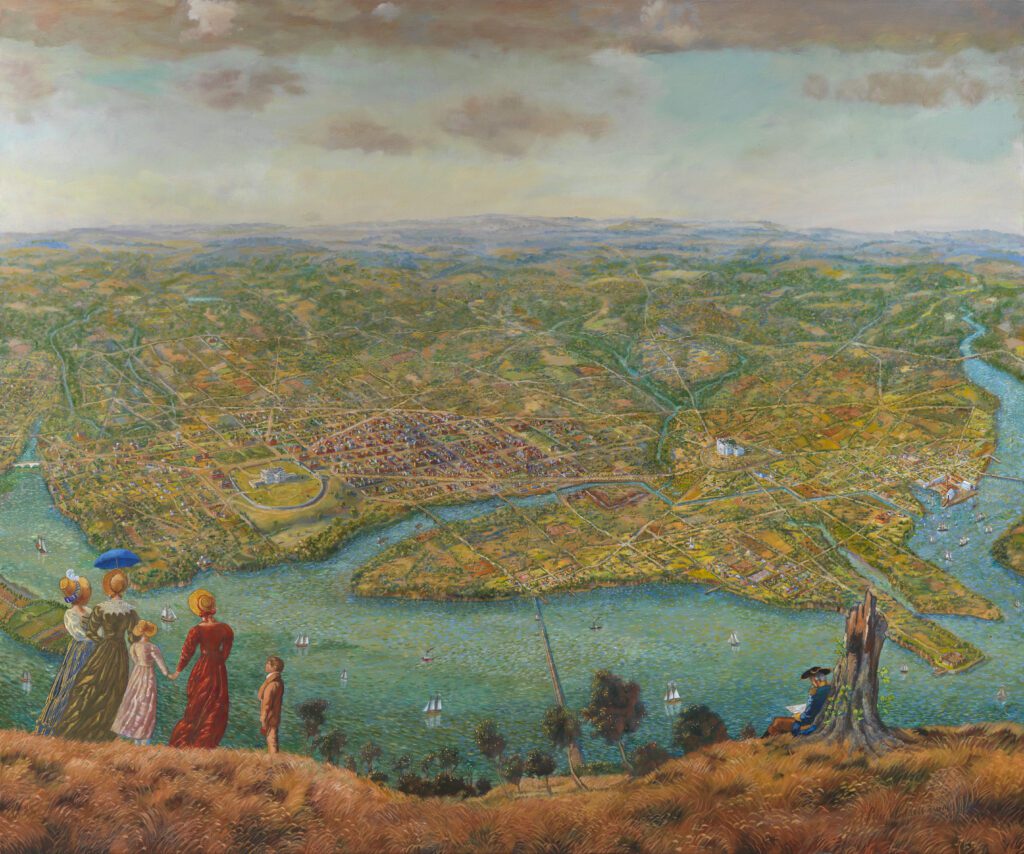
L’Enfant’s plan for the City of Washington drew on the French inspirations of Versailles, the Place de la Concorde, and André le Nôtre’s Jardins des Tuileries and Champs-Élysées, all of which he would have seen during his early artistic education in Paris. Planning a city from the ground up also allowed ample opportunity for symbolism: where the gardens at Versailles and other palaces were reserved for the exclusive use of nobility, the National Mall, or “Grand Avenue,” was a space created specifically for public use. The very design of the capital was meant to represent and reinforce the democratic principles the United States had been founded on.
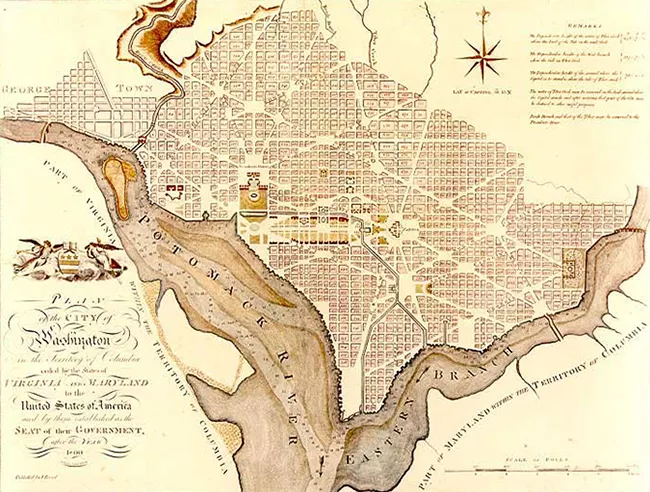
While modern-day DC bears a resemblance to L’Enfant’s plan, it must be remembered that the capital was not built in a day, and modifications were made to the final design as it was constructed. Additionally, L’Enfant’s failure to account for a lack of resources available for the construction of the capital meant that for most of the Federal era, the City of Washington remained more plan than reality.
The city’s lack of physical reality did not mean that the location was uninhabited. With the capital’s move from Philadelphia to Washington in 1800, the city saw an influx of legislators and civil servants—and frequently their families, too. Many of these families sought to settle in the district, and Georgetown, with its industrial resources, port, and easy access to the planned capital, proved a popular location. The former Rock of Dumbarton was especially sought after, as the higher location offered cooler temperatures and less humidity—critical features in an era before air conditioning. The dates during which well-known properties in upper Georgetown were developed speak to the influx of wealthy new Washingtonians during the first decade of the 19th century: the core of what is now known as Dumbarton Oaks was built in 1801, the Samuel Davidson House (now known as Evermay, which borders Dumbarton House to the north) was built between 1801 and 1804, and Tudor Place, the residence of the Peters family, was built in 1805.
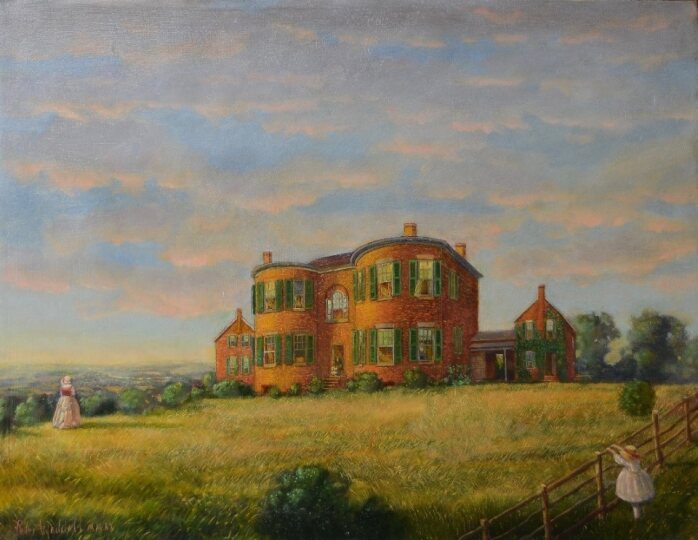
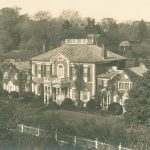
Dumbarton House was among the properties constructed in response to the arrival of the capital. Constructed between 1799 and 1800 by Samuel Jackson, merchant and speculator from Philadelphia, it maintained the name “Jackson’s House on Cedar Hill” until it was officially renamed “Bellevue” by Charles Carroll when he purchased it in 1813. Originally thought to have been an earlier construction, its dating to 1800 was confirmed during its 1929-1931 renovation, when an 1800 penny was found in the mortar of the front hall.
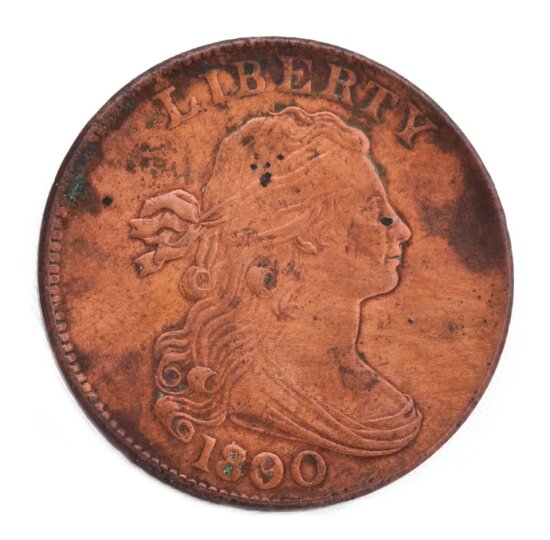
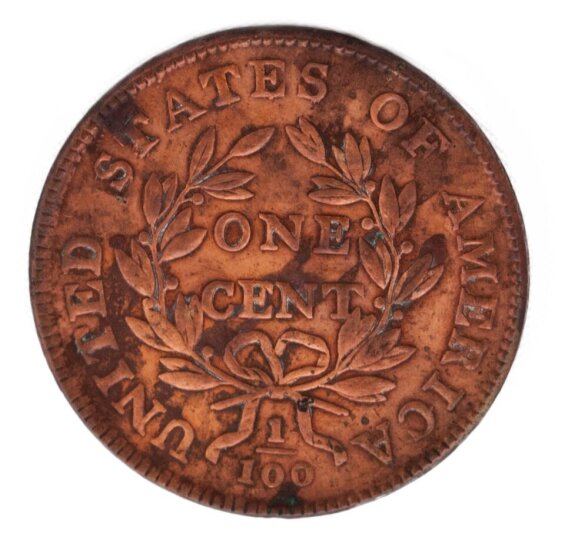
31.04.1, Penny found in front hall of Dumbarton House
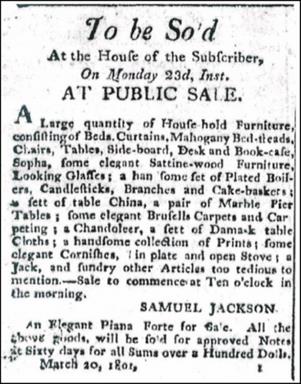
Jackson was already under some financial strain when he moved to Washington, and it appears that he constructed his house in Georgetown in an attempt to appear credit-worthy. The construction of the house bankrupted Jackson, who mortgaged the property to William Shannon in 1799, but was forced to sell the house—and its mortgage—in 1800, when he auctioned off his furniture in haste and moved his family to Virginia and later Tennessee. The mortgage was then assumed by subsequent owners, and when it came due in 1801 the property defaulted to the United States government.
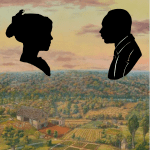
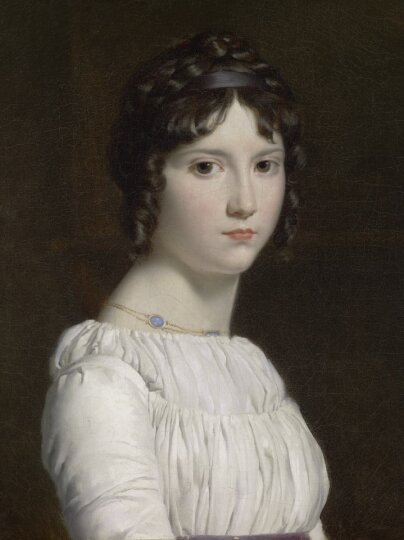
Until recently, it was thought that the house had stood vacant until it was purchased by Joseph Nourse in 1804. However, recent research has suggested that the property served as the home of the first French ambassador to the United States, Louis-André Pichon, who would have lived there with his wife Émilie from 1802 to 1804. The Pichons set sail for America in December 1800, mere days after their wedding had taken place, and arrived in early 1801. The couple was by all accounts well-connected in Washington society, with their social circle comprising Thomas Jefferson, James and Dolley Madison, and Margaretta Mason Brown, in whom Émilie appears to have found a kindred spirit. Research shows that they occupied five separate residences during their time in Georgetown, with Dumbarton House serving as their residence from 1802 to May or June 1804. During their time there, Émilie gave birth to their first child, Louis-Alexandre, while André would have been involved in the negotiations that resulted in the Louisiana Purchase in 1803. During this time, he signed Merriwether Lewis’ passport, granting Lewis and Clark passage through what was at the time still French Territory.
The Commissioner General of Trade Relations chargé d’affaires of the French Republic, undersigned, requests all those to whom this present shall be delivered, officials of the government of the French Republic, captains and commanders of vessels or land forces of the Republic, and moreover all the French Citizens, to give protection and aid to the bearer, Captain Merriwether Lewis, Citizen of the United States, who, by authority of the President of the said United States, is setting out on a voyage of discovery with the purpose of exploring the Missouri river and the western regions of the Northern Continent. The undersigned certifies that Captain Merriwether Lewis has no purpose other than the above, that he carries with him only the goods and merchandise fitting to make him well received by the Indians, and his voyage being of a purely scientific nature, and in its end of equal interest to all the civilized world, the undersigned repeats the invitation to all those who may be requested to give him aid and assistance, likewise his travelling companions who are in number [blank]. Given at Georgetown near the town of Washington, 10 Ventose year 11 [1 March 1803] and sealed with the seal of the legation. L. A. PICHON
The Pichons vacated Dumbarton House in the late spring of 1804, which is consistent with Gabriel Duvall’s purchase of the house at auction from the United Sates government on May 4 of that year. On May 11, Duvall then sold it with a four-year mortgage to Joseph Nourse, who spent the summer making improvements to the property before moving in with his wife Maria in August.
Born in London in 1754, Joseph Nourse had immigrated to the American colonies in 1769 with his family. During the Revolution, he served as secretary to General Charles Lee, and in 1781, he was elected the first Register of the Treasury. Nourse was among the civil servants who moved with the government from Philadelphia to Washington in 1800, where he lived at what is now 3101 P Street before purchasing “Jackson’s House on Cedar Hill” from Gabriel Duvall in 1804.
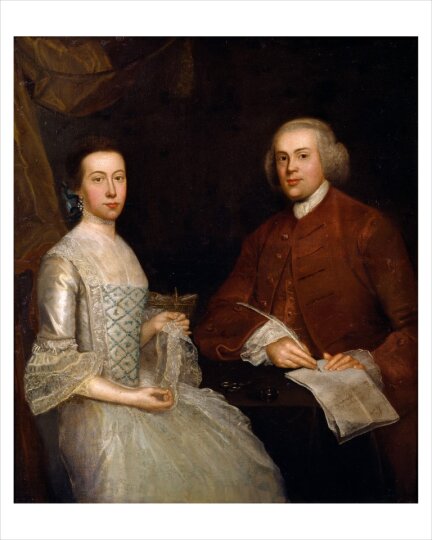
Nourse’s renovations to the house were as extensive as they were well-documented. As part of his improvements, Nourse had the windows replaced, a doorway built to connect the Breakfast Room to the kitchen, an ice house built, and notably, spent $62.00 on wallpaper alone. Like Pichons before them, the Nourses were close with the Madison family, with Joseph Nourse purchasing a set of furniture that had once been intended for the White House.
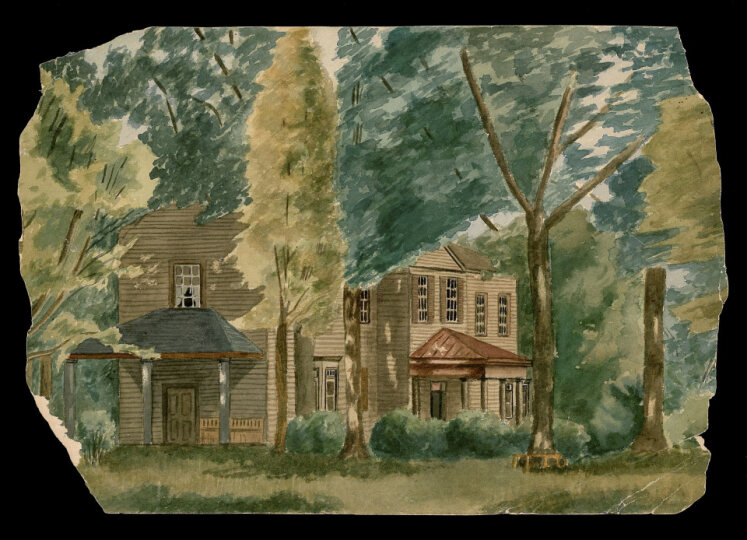
The Nourses lived at Cedar Hill until 1813, when they sold the property to Charles Carroll of Bellevue and moved further up the Rock of Dumbarton to a new property, named Mount Alban.
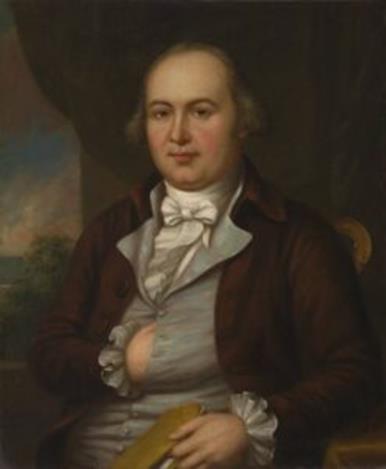
Despite owning the property for several decades, the Carroll family only lived there until 1815. Charles Carroll, known as Charles Carroll of Bellevue, was a cousin of Declaration of Independence signer Charles Carroll of Carrollton. Upon purchasing the property from Joseph Nourse, he renamed it Bellevue, after his other estate outside of Hagerstown, Maryland.
Likely the best-known event from Charles Carroll’s residence at Bellevue is his contribution to Dolley Madison’s escape from Washington during the War of 1812. On August 24, 1814, Dolley Madison fled the capital ahead of the British advance with her sister Anna Payne Cutts’s family and a carriage full of official papers, red velvet curtains, and silver. In a letter to her sister Lucy Payne Todd, she wrote:
“Our kind friend, Mr. Carroll, has come to hasten my departure, and is in a very bad humour with me because I insist on waiting until the large picture of General Washington is secured, and it requires to be unscrewed from the wall. This process was found too tedious for these perilous moments; I have ordered the frame to be broken, and the canvas taken out. It is done! and the precious portrait placed in the hands of two gentlemen from New York, for safekeeping.
And now, dear sister, I must leave this house, or the retreating army will make me a prisoner in it by filling up the road I am directed to take. When I shall again write to you, or where I shall be tomorrow, I cannot tell!“
– Dolley Madison Papers, Manuscript Division, The Library of Congress
The information in Dolley’s letter was corroborated by a separate letter written by Navy Secretary William Jones, who would meet her group at Bellevue:
“I left the Navy yard at about half past three o’clock accompanied by Mr. Duval and not long after learned that our army was rapidly retreating and that of the enemy advancing rapidly. We proceeded to Georgetown where I met my family and that of the Presidents at the house of Charles Carrol [sic] Esq of Belle Vue and received a message from the President requesting that I would join him at Foxalls works. At about 5 oclock I set out in company with the family of the President, of Mr. Carrols [sic] and my own, with Mr. Duval and proceeded through Georgetown to join the President but found he had crossed at Masons ferry.“
– William Jones Papers, The Historical Society of Pennsylvania
The British, led by Major General Robert Ross, entered the capital city on August 24, 1814 burning the Capitol and President’s House. In addition to these two highly symbolic buildings, nearly all public buildings in the city were burned, an erasure of the planned capital in retaliation for the American burning of the Canadian capital of York (now Toronto) in 1813. While the British did spare most private property, some of the fires did spread to residential areas, which also suffered looting by invading forces. It was only due to the onset of a sudden, heavy rainstorm that the fire did not cause more damage to the buildings selected for burning.
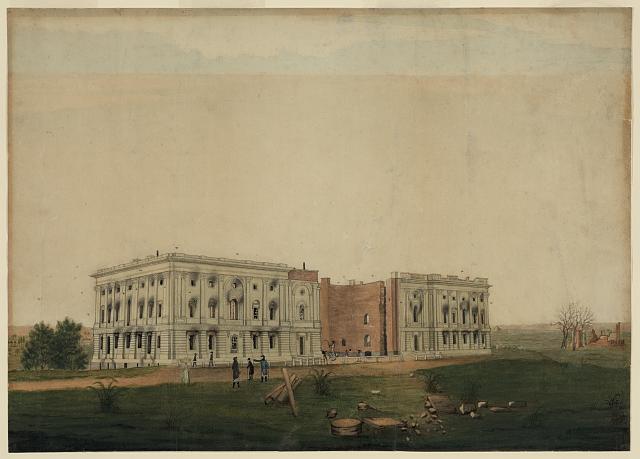
The government returned to Washington the following month, although the War of 1812 would not end until the signing of the Treaty of Ghent on December 24, 1814. The Carrolls would leave the District in 1815, effectively turning Bellevue into a rental property for the next 30 years. The capital they left behind looked very different from the one that had been moved there in 1800. While a city had begun to form around the framework of L’Enfant’s plan, the burning of Washington meant that the capital would need to be rebuilt almost from the ground up. The United States, which had already lacked the funds to complete the capital as L’Enfant had planned it prior to the War of 1812, did not have the ability to fully rebuild. While some buildings, like the Old Brick Capitol, were reconstructed in under a year, the rebuilding of the White House and Capitol would take years, with the Capitol only being ready for use in 1819, and fully completed by the mid-1820s.
Written by Curator of Archives and Collections, Isabella Kiedrowski
May 2026
Bibliography:
“A Capitol in Ruins.” U.S. Senate: A Capitol in Ruins, August 7, 2023. https://www.senate.gov/about/historic-buildings-spaces/capitol/capitol-ruins.htm.
Delambre, Luc, and Edmée Delambre. Servir la France napoléonienne à Washington: Lettres d’Amérique: Emilie et andré Pichon-Brongniart, 1801-1805. Paris: L’Harmattan, 2020.
“Dolley Madison.” Dumbarton House. Accessed April 29, 2026. https://dumbartonhouse.org/dolley-madison/.
“A French Diplomat Grants Lewis and Clark a Passport · SHEC: Resources for Teachers.” Social History for Every Classroom. Accessed April 29, 2026. https://shec.ashp.cuny.edu/items/show/705.
“Joseph Nourse (1754-1841).” Dumbarton House. Accessed April 29, 2026. https://dumbartonhouse.org/joseph-nourse-1754-1841/.
“Louis André Pichon to Thomas Jefferson, 4 March 1803.” Founders Online, n.d. https://founders.archives.gov/documents/Jefferson/01-40-02-0010.
Mould, David H., and Missy Loewe. Remembering georgetown: A history of the lost Port City. Charleston SC: History Press, 2009.
“Research Guides: Residence Act: Primary Documents in American History: Introduction.” Introduction – Residence Act: Primary Documents in American History – Research Guides at Library of Congress. Accessed April 29, 2026. https://guides.loc.gov/residence-act.
“Research Guides: Residence Act: Primary Documents in American History: Introduction.” Introduction – Residence Act: Primary Documents in American History – Research Guides at Library of Congress. Accessed April 29, 2026. https://guides.loc.gov/residence-act?loclr=bloglaw.
“Samuel Jackson Goes to Washington.” Dumbarton House. Accessed April 29, 2026. https://dumbartonhouse.org/samuel-jackson-goes-to-washington/.
White, David D. Ms. THE EARLY HISTORY OF DUMBARTON HOUSE, 1798-1804: A Brief Account. Dumbarton House, 2017.
Willard. “March 1, 1803.” Discover Lewis & Clark, December 12, 2024. https://lewis-clark.org/day-by-day/1-mar-1803/.