From their beginnings as reference pieces for various stitches to Victorian masterpieces, samplers serve as valuable records in the history of women’s education. While frequently overlooked due to their assumed decorative nature, they often contain valuable information about their makers and the world they lived in. The National Society of the Colonial Dames of America’s Sampler Survey, founded in 2023, contains 5,420 samplers produced worldwide between 1600 and 1900, and continues the work Ethel Stanwood Bolton & Eva Johnston Coe’s American Samplers, published in 1921 by the NSCDA in Massachusetts. The Sampler Survey offers a broad selection of samplers, allowing us to view larger trends in the history of sampler making and by extension in the history of female education.
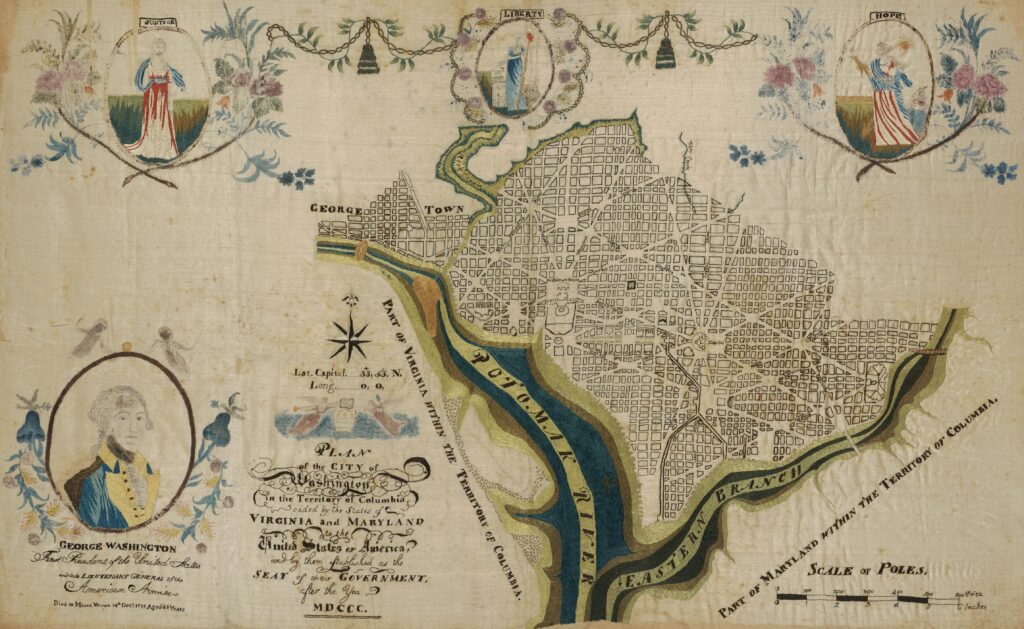
One of the samplers included in the NSCDA Sampler Survey is the Lemoine Sampler, which hangs above the fireplace in the parlor at Dumbarton House. It depicts a map of L’Enfant’s Plan of the City of Washington replicated in silk thread, watercolor, and ink, with the figures of Justice, Liberty, and Hope above and a portrait of George Washington to the left. Attributed to Maria Magdalene Lemoine of Alexandria between 1800 and 1805, it is one of only five such samplers known to survive, all created in the first decade of the nineteenth century, likely originating from the same school in Alexandria, which was then still part of the 10-mile square of the District of Columbia.
The Lemoine sampler was purchased by Dumbarton House in 2010, becoming the third known version of an embroidered plan of Washington in a museum collection. Since then, two more samplers have come to light, most recently a sampler stitched by Grace Turner Cleaver around 1802, acquired by the Mount Vernon Ladies’ Association in 2022.
These five samplers, created in the earliest days of the American Republic, preserve an idea of the early nation as well as the position women and girls held in it. To better understand the Lemoine sampler and its four companions, we must look at them through the lens of girls’ education in early America, as well as in the context of other samplers produced in the Colonial era and Early Republic.
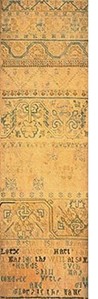
The first samplers began to appear in Europe in the 1500s, as collections—or “samples”—of different types of stitches and designs. These were useful objects, designed to be used as reference examples or patterns. Over time, these long, narrow, and random assortments of designs took on a more decorative purpose, becoming examples of excellence and creativity, rather than reference pieces. By the 1600s, samplers were an established part of female education, used both as a teaching tool and proof of accomplishment.
The first sampler known to have been created in America was stitched by Loara Standish, the daughter of Captain Miles Standish of Duxbury, in Plymouth Colony, sometime after 1627. Clearly a decorative piece, it still refers back to the original style of the long and narrow samplers, and features a verse at the bottom:
Loara Standish is my name
Lord guide my heart that I may do thy will
Also fill my hands with such convenient skill
As may conduce to virtue void of shame
and I will give the glory to thy name
The verse sets the sampler apart as not just a reference or decorative piece. Those looking at this sampler would have been able to deduce Loara’s social status and level of education from this sampler—without having to quiz her. It stood as proof that she had been taught her letters, and was therefore able to read; that she had been taught a very high level of embroidery by an exceedingly skilled individual; and that she had the time to create an object that was not purely useful, like a shirt. Furthermore, the verse implied that she had been brought up to be devout and virtuous—a critical part of both male and female education at the time. This sampler, which served on one hand as proof of her education, skill, and virtue, also served as a reminder to the viewer to ask for divine help so that they might do God’s will—and so the finished sampler, used to teach the student who embroidered it, became a teaching tool upon its completion.
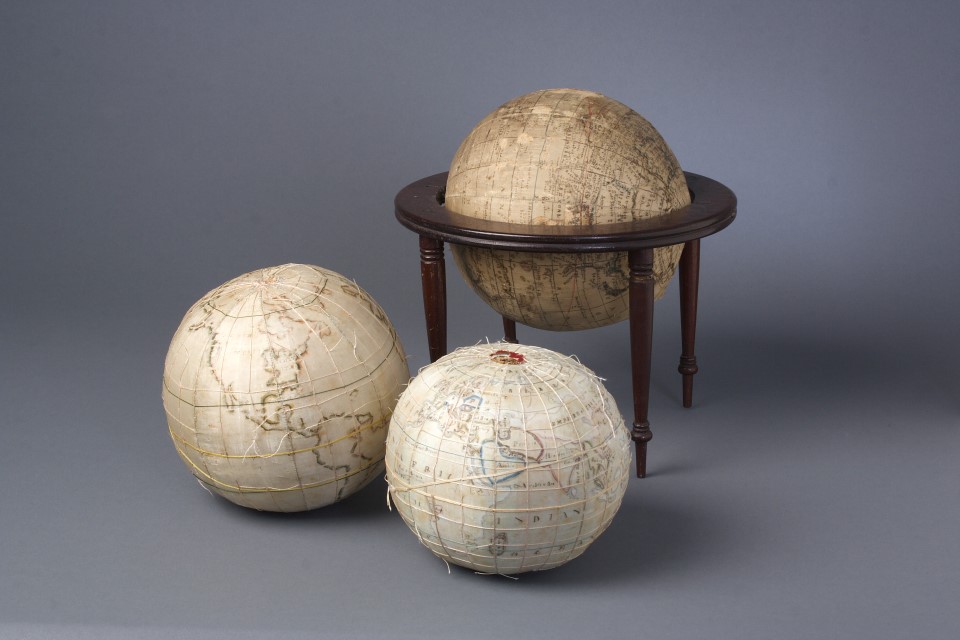
Unlike the early American samplers featuring verses designed to impress moral virtue on both stitcher and viewer, the samplers produced in Alexandria are more akin to the embroidered globes produced at the Westtown Quaker School near West Chester, PA. Westtown School, a coeducational boarding school whose curriculum, modeled on that of the Ackworth School in Yorkshire, England, featured writing, grammar, reading, arithmetic, geography, natural sciences, astronomy, and bookkeeping. The gendered subjects were surveying for boys and sewing for girls. The globes themselves are condensed packaged of academic achievement, showing proof of mastery of both geometry and geography (sometimes also astronomy), as well as great artistic skill.
While there are no globes included in the NSCDA’s sampler survey, forty-one of the 5,420 samplers listed in the survey are embroidered maps. Thirty-four of these are dated, and fall between the years of 1780 and 1870. While pretty evenly split between maps created in America and maps created in England, Scotland, and Ireland, it is interesting to note that the numbers are higher in England until about 1800, at which point numbers of embroidered maps increase in America. This seems to suggest that, despite America’s recent successful bid for independence, the young nation was still taking its educational cues from Great Britain.
Number of Map Samplers by Decade, 1780-1870
| Decade | Total | England/ Scotland/Ireland | America |
| 1780-1789 | 2 | 2 | |
| 1790-1799 | 9 | 6 | 3 |
| 1800-1809 | 13 | 5 | 7 |
| 1810-1819 | 3 | 2 | 1 |
| 1820-1829 | 3 | 3 | |
| 1830-1839 | 4 | 2 | 2 |
| 1840-1849 | 1 | 1 | |
| 1850-1870 | 1 | 1 |
The rise in embroidered maps produced in the first decade of the 19th century shows the shift that had taken place in girls’ education over the past two centuries. By the mid-eighteenth century, geography, mathematics, and history were established subjects for the daughters of the merchant and upper classes. Following the American Revolution, the idea was introduced that American education should differ from that in England or on the Continent. Furthermore, a country founded on the principle of liberty and justice for all should make an effort to educate its female citizens, as well. Benjamin Rush, in his 1787 Thoughts Upon Female Education, stated that
The equal share that every citizen has in the liberty and the possible share he may have in the government of our country make it necessary that our ladies should be qualified to a certain degree, by a peculiar and suitable education, to concur in instructing their sons in the principles of liberty and government
According to Rush, the education of the American girl should include “a knowledge of the English language,” writing, “some knowledge of figures and bookkeeping,” “an acquaintance with geography and some instruction in chronology,” “vocal music,” and dancing. The academic reading list ought to include “history, travels, poetry, and moral essays.” Thus, she would “qualify…not only for a general intercourse with the world but to be an agreeable companion for a sensible man.”
In 1798, Judith Sargent Murray, writing under the pseudonym “Constantia,” celebrated the new era in women’s education taking place in the newly formed United States:
“And, first, by way of exordium, I take leave to congratulate my fair country-women, on the happy revolution which the few past years has made in their favour; that in these infant republics, where, within my remembrance, the use of the needle was the principal attainment which was though necessary for a woman, the lovely proficient is now permitted to appropriate a moiety of her time to studies of a more elevated and elevating nature. Female academies are every where establishing, and right pleasant is the appellation to my ear. Yes, in this younger world, “the Rights of Women” begin to be understood…”
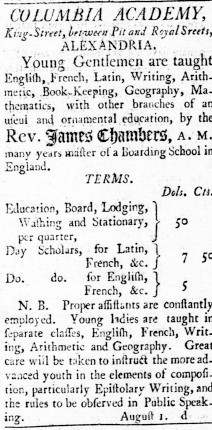
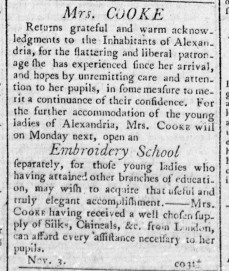
The growing idea of education as a right belonging to all regardless of gender is confirmed by newspaper advertisements of the era. As Murray wrote, “Female academies are everywhere establishing.” An 1801 advertisement for the Columbia Academy in Alexandria states that “Young ladies are taught […] English, French, Writing, Arithmetic and Geography.”2 Notably, the curriculum did not include any form of handwork, which was rather unusual for the time. Students seeking to advance in needlework could have conceivably attended Mrs. Cooke’s “Embroidery School”, which opened in Alexandria that same year. Mrs. Cooke established her school “for those young ladies who, having attained other branches of education, may wish to acquire that useful and truly elegant accomplishment.”
Mrs. Cooke continued to teach in Alexandria until at least 1803, if not later, and is considered one of the possible teachers who may have taught using the Plan of Washington that resulted in the five embroidered maps, including the Lemoine sampler.
Another option is Mrs. Edmund Edmonds, whose 1810 newspaper advertisement informs that public that her “school for the tuition of young ladies” would teach “Reading, Writing, Arithmetic and English Grammar, Drawing, Painting in inks and colors, on satin, tiffany, &c., &c. and dresses in durable ink. Embroidery in chenilles, gold, silver and silk. Maps wrought in [ditto]. Print work in figures, or landscapes. Tambour, and Needle work, plain and fanciful. Fringe, and Netting, in all its variety.”4 Notably, Mrs. Edmonds is the first to advertise “wrought” or embroidered maps. Since no evidence confirming either woman as the instructor exists exists, however, the teacher’s identity has yet to be determined.
The existence of five maps, with identical subjects and related motifs, points to one teacher having taught all five girls. While a deviation from the sampler in the traditional sense, the Lemoine sampler used at least half a dozen types of stitches and a full gradient of colors, both dyed silk and metal-wrapped. This sampler would likely have been one of the finest pieces Maria Madgalene would have produced in her time at school, possibly even as the culmination of her education. A sampler of this scale—19.25 by 32 inches (48.9 x 81.2 cm)—and type was the packaging of all subjects she had been taught into one showstopping item that could be displayed to show off both her academic accomplishments and her skilled needlework, both of which would be assets in this new republic, which prized both practical and academic achievements.
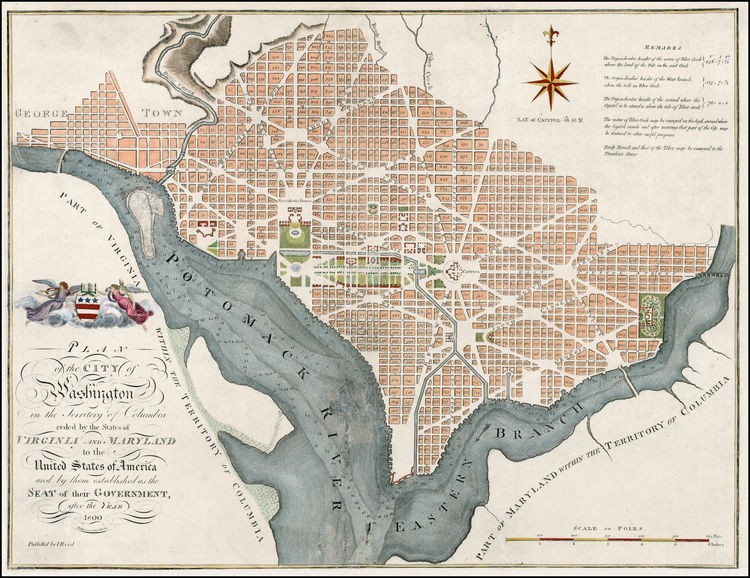
The Lemoine sampler and its four likenesses also capture a unique moment in the history of the nation’s capital: a time when the idea and ideals of the capital—and indeed the nation itself—were more real than the place itself. When Maria Magdalene created her sampler, the City of Washington was not yet the city of L’Enfant’s plan, although the plan lived in the minds of those who lived there. The prevalence of this planned future city may be one of the reasons that L’Enfant’s plan was chosen as the subject of the five Alexandria samplers. But the three cartouches also point to the philosophical ideals held by the citizens of the early republic: Liberty, Justice, and Hope, subjects that would be at home in an earlier style of sampler.
The placement of these three cartouches is no accident: four out of five of the samplers, including Maria Magdalene Lemoine’s, feature the central image of Liberty, flanked on either side by Justice and Hope.5 In an age of allegorical imagery, this placement cannot be seen as random. A central placement of Liberty reinforces the importance of liberty to the idea of America—as central as the idea of the capital would have been at the time. But Liberty alone is unsustainable, and cannot exist without Justice to secure it and Hope to carry it forward. Much like the new government of the United States, this is a trinitarian system that needs all its parts to survive. In some ways, this sampler can be seen as a new take on the religious and moral samplers which were the norm, focusing on the ideals of Liberty, Justice, and Hope, impressing them on the viewer, and urging them to take all three into account when moving forward as citizens of this new country.
The Lemoine sampler, with its focus on both the past revolution and the future plans for the new nation’s capital, captures a moment of great change in American history and society, a time when the ideals of the growing nation meant that its citizens were still investigating what their roles might become. For some, these ideals would lead to more opportunities and education; for others, they would lead to tighter restrictions on both. Some southern states already prohibited teaching enslaved individuals to read and write, but following Nat Turner’s Rebellion in 1831, all states except Maryland, Kentucky, and Tennessee passed laws prohibiting the education of the enslaved. It must be remembered that the Lemoine sampler, while a symbol of the increased education and opportunities available to girls, is also a symbol of great privilege. Women’s education may have been on the rise, but newspaper advertisements for ladies’ academies were always outnumbered by announcements advertising the sale and purchase of slaves.
By the end of the Federal Era, needlework as a school subject had begun to fall out of favor, being considered a somewhat outdated mode of education. As options for education and a greater variety of academic subjects became available to the young women of America, needlework was pushed out of the academic curriculum. This is not to say that needlework ceased to be practiced—it was simply relegated to leisure or practical work, rather than academic pursuits.
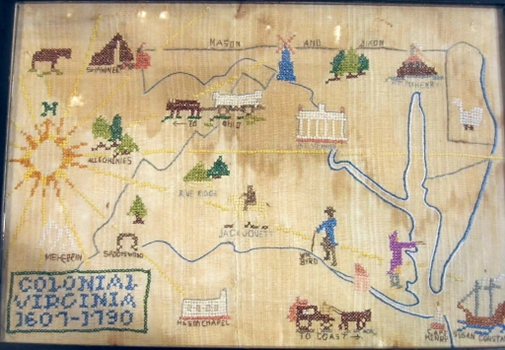
As needlework took a back seat to academics, embroidered maps fell almost entirely out of fashion. The NSCDA Sampler Survey lists only two embroidered maps created after 1840, the most recent of which dates to between 1857 and 1876. Executed almost entirely in cross stitch, it is much simpler than its predecessors, but its maker, now unknown, seems to have been inspired by earlier examples when depicting “Colonial Virginia 1607-1790″, according to the legend in the lower lefthand corner. Now a part of the Loudoun Museum’s collection, its object file notes that it may have been created either for the 250th anniversary of the founding of Jamestown, which would date it to 1857, or as a centennial project in 1876. Likely a school project, it serves as a later example of embroidery being used to teach history and geography. Both in style and subject, inspiration was likely drawn from the heyday of embroidered maps, that narrow period of time when the widening academic, domestic, and artistic spheres overlapped in American girls’ education.
Written by Curator of Archives & Collections, Isabella Kiedrowski
March 2026
Notes
- Alexandria Advertiser and Commercial Intelligencer, Volume 1, Number 201, 3 August 1801 ↩︎
- Alexandria Advertiser and Commercial Intelligencer, Volume 1, Number 201, 3 August 1801 ↩︎
- Alexandria Advertiser and Commercial Intelligencer, Volume 1, Number 280, 3 November 1801 ↩︎
- Columbia’s Daughters: Girlhood Embroidery from the District of Columbia, Gloria Seaman Allen, Chesapeake Book Company, 2012 ↩︎
- Elizabeth Graham’s sampler, now in Winterthur’s collection, is the exception: as in the other samplers, Justice and Hope are in the corners, but the cartouche with Liberty is in the lower right hand corner. ↩︎
Bibliography:
- “Sewn in Place: Gender, Materiality and Mapmaking in the Early United States” Elizabeth B. Eager, 2024
- “A World of Learning: The Embroidered Globes of Westtown School” Mary Uhl Brooks, Piecework Magazine, Winter 2024
- Samplers & Samplermakers: an American schoolgirl art, 1700-1850, Mary Jaene Edmonds, Rizzoli/Los Angeles County Museum of Art, 1991
- Learning to stand & speak : women, education, and public life in America’s republic, Mary Kelley, University of North Carolina Press, 2006
- Columbia’s Daughters: Girlhood Embroidery from the District of Columbia, Gloria Seaman Allen, Chesapeake Book Company, 2012
- Samplers: Mapped and Charted, Whitney Antiques, 2005
- “Marvelous Maps: Five schoolgirl embroideries of the Plan of the City of Washington ca. 1800” Virginia Whelan, Dames Discovery Spring/Summer 2023, Vol. 33, No. 1
- Bejamin Rush, Thoughts Upon Female Education, 1787
- Tyner, Judith A. Stitching the World: Embroidered Maps and Women’s Geographical Education, Routledge, New York,2015