Being removed from the capital city, Georgetown suffered less destruction during the burning of Washington, but the years following the War of 1812 still required rebuilding. Many Georgetowners worked across the creek in the capital city, and their daily lives and livelihoods had been impacted by the conflagration. Georgetown itself was undergoing its own transformation. Previously known as one of the largest tobacco ports in the country, its harbor had begun to fill with silt, requiring the town to change its focus from export to industry. Mills, while already common, began to proliferate along Rock Creek, with grist milling becoming the second-largest industry in the District.
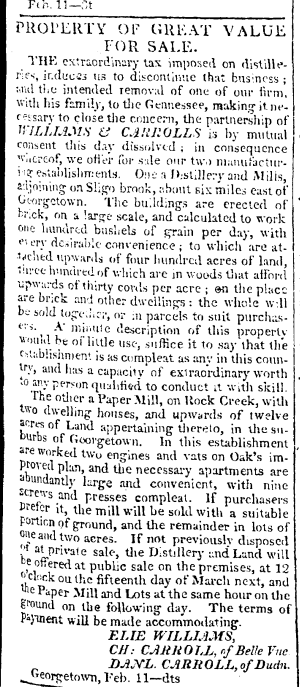
One of the Rock Creek mill owners was Charles Carroll, who lived at Dumbarton House (then known as Bellevue) from 1813 to 1815. In February 1815, while planning to move to New York, Carroll advertised his paper mill, which he owned with Elie Williams and his cousin Daniel Carroll of Duddington, as a “Property of Great Value,” with “two dwellings, and upwards of twelve acres of Land […] in the suburbs of Georgetown.” In addition to the paper mill, the trio also owned a distillery with an adjoining mill on Sligo Creek, which they advertised as having “a capacity of extraordinary worth to any person qualified to conduct it with skill.”
GEORGETOWN VS. THE ERIE CANAL VS. THE BALTIMORE & OHIO
Part of the decline of the port of Georgetown was that American commerce was no longer aimed purely towards the Atlantic. As the United States expanded further into the North American continent, so did its population and its economy. Goods now needed to be shipped west as well as east. While the lack of a Northwest Passage meant that there was no direct water (and therefore shipping) route across the continent, goods could still make their way further inland from port cities via naturally occurring rivers or manmade canals.
The Erie Canal, completed in 1825, was the first navigable waterway connecting the Atlantic Ocean to the Great Lakes, via the Hudson River and Niagara Falls. This canal served as an artery into the heartland, where states like Indiana, Illinois, and Missouri had recently been admitted to the Union, and could participate economically due to this link. For the ports along the Potomac, having a canal of their own would allow them a chance to compete with the northern ports who had the Erie Canal at their disposal.
In 1828, ground was broken on the Chesapeake & Ohio Canal. As the name suggests, it was designed to link the Chesapeake Bay to the Ohio River, and by extension the western territories. Its supporters hoped that it would connect the capital to the west and replace the older Patowmack Canal, which could only operate during certain times of the year. Originally planned to be built in two sections, the final plan involved building the canal in three sections, with an eastern section stretching from Georgetown to Cumberland, Maryland, a longer middle section ending at the confluence of the Casselman and Youghiongheny Rivers, and a third section ending in Pittsburgh. The first segment of the eastern portion of the canal, between Little Falls and Seneca, opened in 1830, and the Georgetown end of the canal opened in 1831.
Ultimately, only the eastern section of the C&O canal would be built, with the terminus in Cumberland opening in 1850. Unfortunately, the Baltimore & Ohio Railroad had been operating out of Cumberland since 1842, out-competing the canal. While the C&O would not become the conduit to the west its builders had hoped for, it continued to serve as a link between Washington and western Maryland, delivering mail, passengers, and goods until it ceased operation in 1924.
GEORGETOWN, THE SLAVE TRADE, AND URBAN ENSLAVEMENT
While it would not be able to expand westward economically, one area in which Georgetown continued to profit—and would continue to profit from until 1850—was the slave trade. In addition to its participation in both the Atlantic and domestic slave trades, Georgetown’s industrial expansion also relied heavily on slave labor. At home, the mill owners also relied on enslaved labor to keep their households running without the expense of keeping free servants.
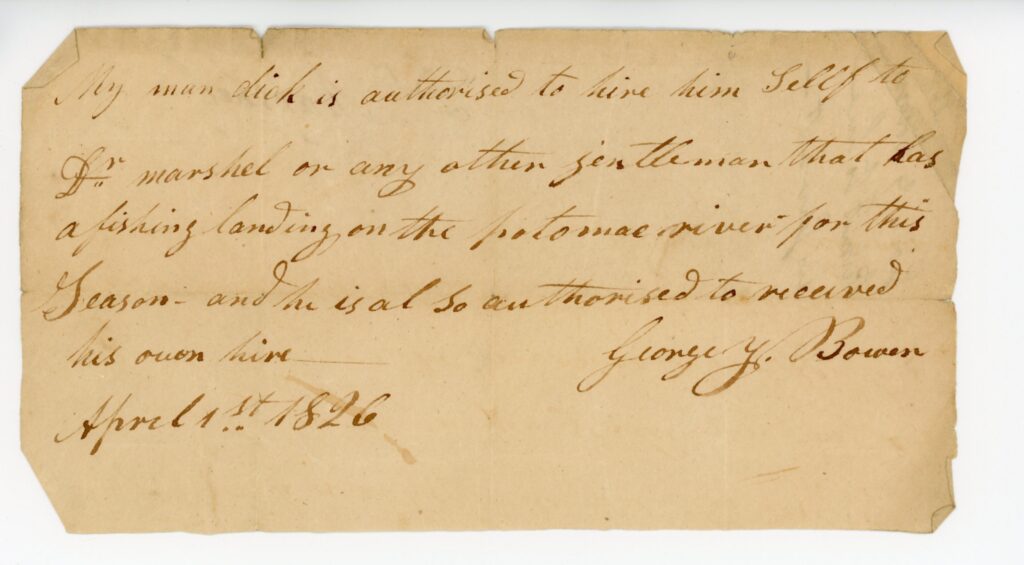
A subset of Georgetown’s economy centered around hiring out enslaved labor. A facet of urban enslavement that was not present in rural or plantation enslavement was that slave owners could hire out individuals enslaved to them, with the wages earned by the enslaved being paid to the owner. In some cases, as shown by this receipt in the Dumbarton House archives, an enslaved individual was authorized to keep wages they earned. From this receipt, we learn that a man known as Dick was authorized to both to hire himself out—to choose his employer—and to receive the wages he had earned, which was a degree of freedom not afforded to all individuals in Georgetown. As he was authorized to hire himself out through fishing on the Potomac, it is likely that he was hired by Samuel Whitall, who lived at Dumbarton House from the 1820s until his death in 1855, and owned a fishery on the Potomac River.
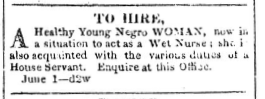
Hired out slaves could occupy any position, as these advertisements from the National Intelligenger show.
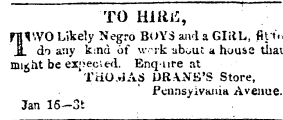
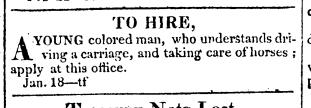
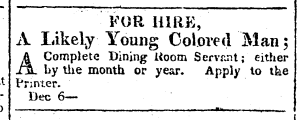
Frederick Douglass, who had been born into slavery on the Eastern Shore of Maryland, described his experience and observations of urban enslavement in stark contrast to his early experience of enslavement on a plantation.
“I had resided but a short time in Baltimore before I observed a marked difference, in the treatment of slaves, from that which I had witnessed in the country. A city slave is almost a freeman, compared with a slave on the plantation. He is much better fed and clothed, and enjoys privileges altogether unknown to the slave on the plantation. There is a vestige of decency, a sense of shame, that does much to curb and check those outbreaks of atrocious cruelty so commonly enacted upon the plantation. He is a desperate slaveholder, who will shock the humanity of his non-slaveholding neighbors with the cries of his lacerated slave. Few are willing to incur the odium attaching to the reputation of being a cruel master; and above all things, they would not be known as not giving a slave enough to eat. Every city slaveholder is anxious to have it known of him, that he feeds his slaves well; and it is due to them to say, that They wanted to send the impression that slaves were not treated so poorly.. There are, however, some painful exceptions to this rule.”
Frederick Douglass, “Narrative of the Life of Frederick Douglass, An American Slave, Written by Himself”1845
While it might have been preferable to rural enslavement, urban enslavement was still enslavement, and local newspapers were filled with advertisements offering rewards for runaway slaves, showing how untenable life was for Georgetown’s 1,526 enslaved.1
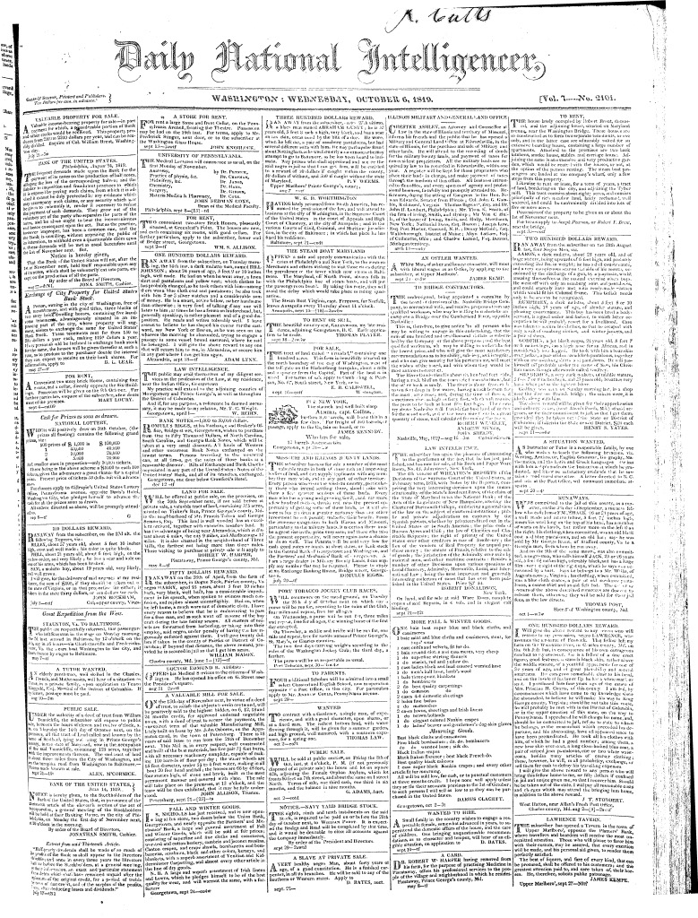
This page of advertisements from the October 6, 1819 National Intelligencer provides a glimpse of how inextricably linked Georgetown and its surrounding area were with slavery. It features six advertisements for escaped slaves, one notice advertising the sale of an enslaved man “to any of the Southern or Western states”—likely as a punishment—and a notice of captured slaves being held in the Washington county jail
MEANWHILE, AT DUMBARTON…
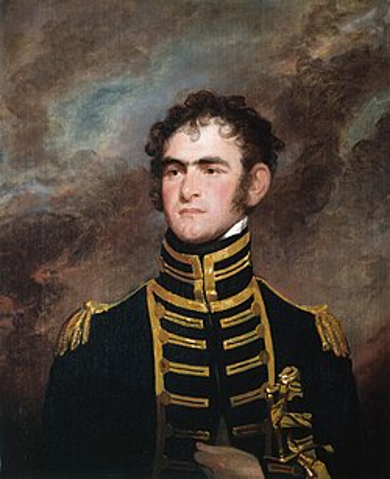
Following the Carroll family’s departure in 1815, Dumbarton House—then known as Bellevue—operated as a rental property, passing through the hands of at several sets of tenants. While there is no conclusive information on its tenants from 1815 to 1817, some sources point to the house having been rented to Commodore John Rodgers during these years.
Around 1817, Carroll began renting the house to South Carolina representative Henry Middleton, whose term in the House of Representatives lasted from 1815 to 1819. Based on a letter to from Charles Carroll to Daniel Carroll of Duddington, it appears Middleton intended to purchase the property in 1818, but ended up renting it instead.
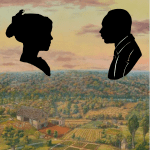
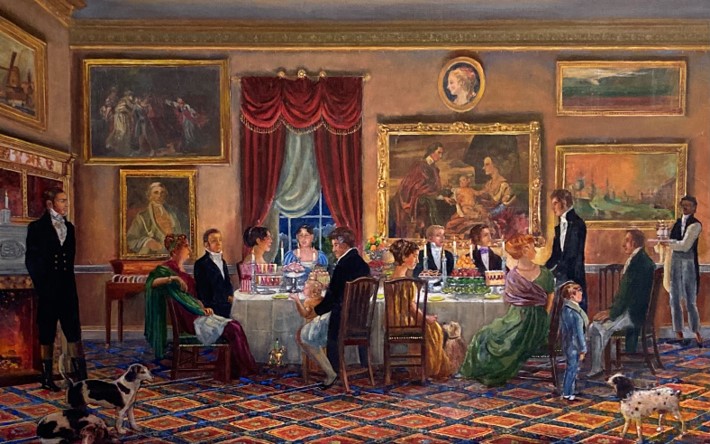
Henry Middleton was the 43rd Governor of South Carolina from 1810-1812, and represented South Carolina in the U. S. Congress from 1815-1819.The Middletons were a well-connected couple, and due to its size Bellevue was well-situated for political entertaining. One of these events is depicted in Peter Waddell’s The Dinner Party, the third painting in his “Ages of Dumbarton” series, and is based on a diary entry written by John Quincy Adams:
“…Mrs. Adams called for me at the office at 5 OClock, and after leaving Mary Hellan at her mother’s went and dined at Mr. Middleton’s at Georgetown. Mr. and Miss Crowninshield, Judge Johnson of Louisiana, Mr. and Mrs. GW Campbell, Genl. Dickerson, and Genl. and Mrs. Ringgold were there…”
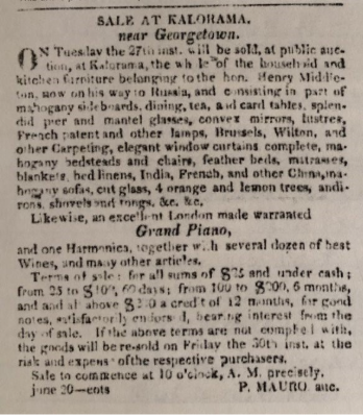
The Middletons rented Bellevue until 1820, when Henry was appointed United States minister to Russia from 1820-1830. When they left Bellevue, they sold off many of their belongings, according to an advertisement placed in the National Intelligencer. This advertisement is one of the only lists of furniture specifically associated with Dumbarton House, and included sideboards, dining, tea, and card tables, mirrors, carpets, featherbeds, and “4 orange and lemon trees”, a well as “an excellent London made […] Grand Piano.” Some of these objects are reflected in the Dumbarton House period rooms today, as well as in Waddell’s painting.
The Carrolls’ final tenants where Samuel and Lydia Whitall, who moved into Bellevue in the early 1820s. Samuel Whitall was born in Red Bank, New Jersey, in 1775 into a prominent Quaker family. He married his first wife, Sarah Ellis, in Trenton in 1796. The family moved to Philadelphia, where Sarah died in 1804, leaving behind Samuel and their three children, Benjamin, Joseph, and Abigail. In 1807, Samuel married Lydia Newbold, also a New Jersey Quaker, in Philadelphia.
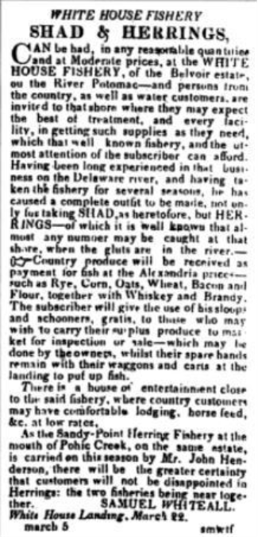
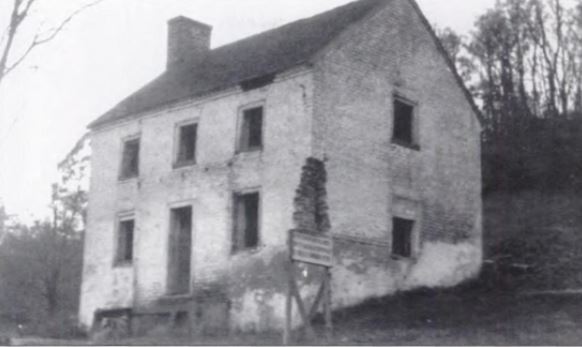
Samuel worked in several different professions. When he first came to the D.C. area, Samuel ran an inn and fishery at White House Landing in Virginia. The name has no relation to the Presidential residence, but refers to a white house that was used as a landmark to identify a landing on the Potomac River. White House Landing was just north of George Washington’s Mount Vernon and served as the closest river access to the famous home. Samuel capitalized on the tourist trade at Mount Vernon and provided room and board to people traveling to or from estate. In addition to his work at the fishery and inn, Samuel worked for John Augustine Washington III as an overseer on some of his farmland.
In addition to his work as a business owner and overseer, Samuel bought and sold land that was formerly part of Washington’s five farms, primarily land from Muddy Hole farm. Samuel bought the land from John Augustine Washington III and usually sold it to other members of the Quaker community. During research, we procured land records from the state and county showing Samuel’s land deals. Some of the transactions were in Lydia’s name in addition to Samuel’s.
Based on census records, we know that Samuel owned a minimum of 7 enslaved individuals and potentially up to 18 enslaved people. These enslaved individuals included children as young as 4 and adults up to the age of 80 or more. There could have been many additional individuals enslaved by the Whitall family who were bought and sold between census years, and so slipped through the historic record.
The Whitalls’ slaveholding is notable, as both Samuel and Lydia were born Quakers. While Quakerism overall was anti-slavery, each congregation decided its own standards. For the Philadelphia Meeting of Friends, for example, the consequence for owning slaves was expulsion, known as “being read out of meeting.” While we have no records of the Whitalls’ expulsion, there are no records of them having belonged to a Quaker meeting after moving to the D.C. area, where they enslaved between 7 and 18 individuals.
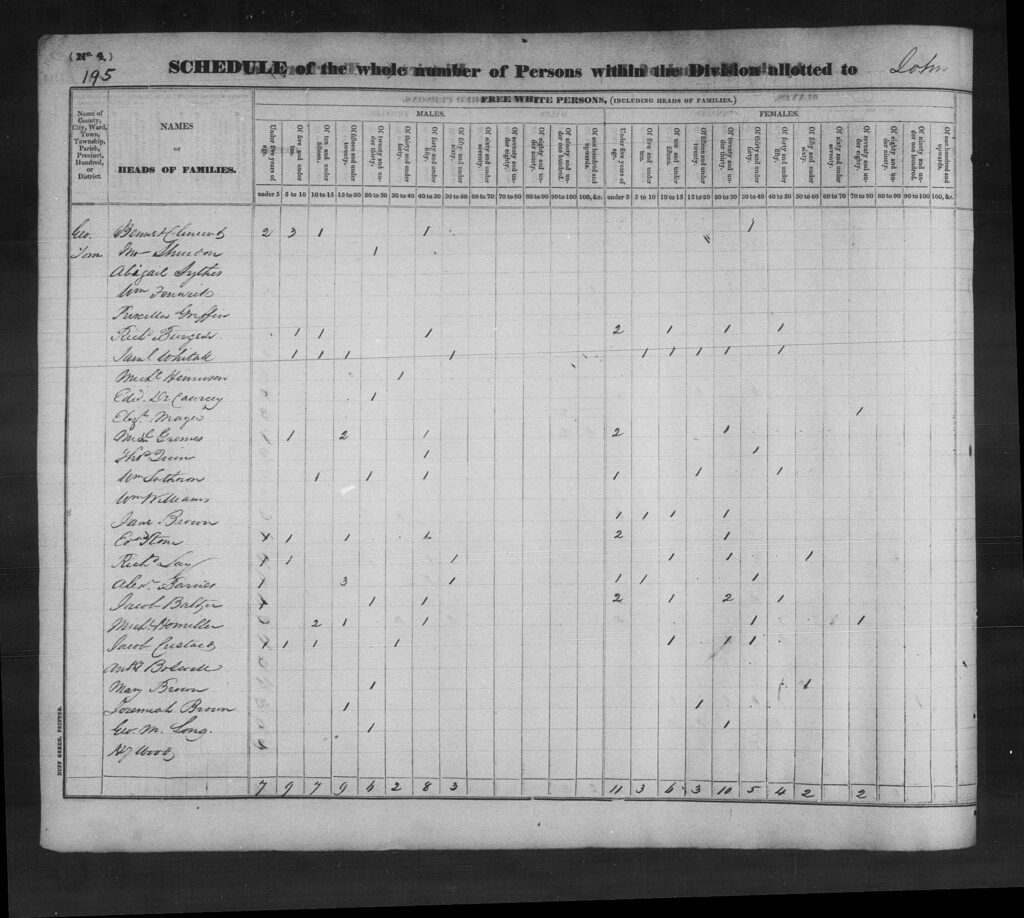
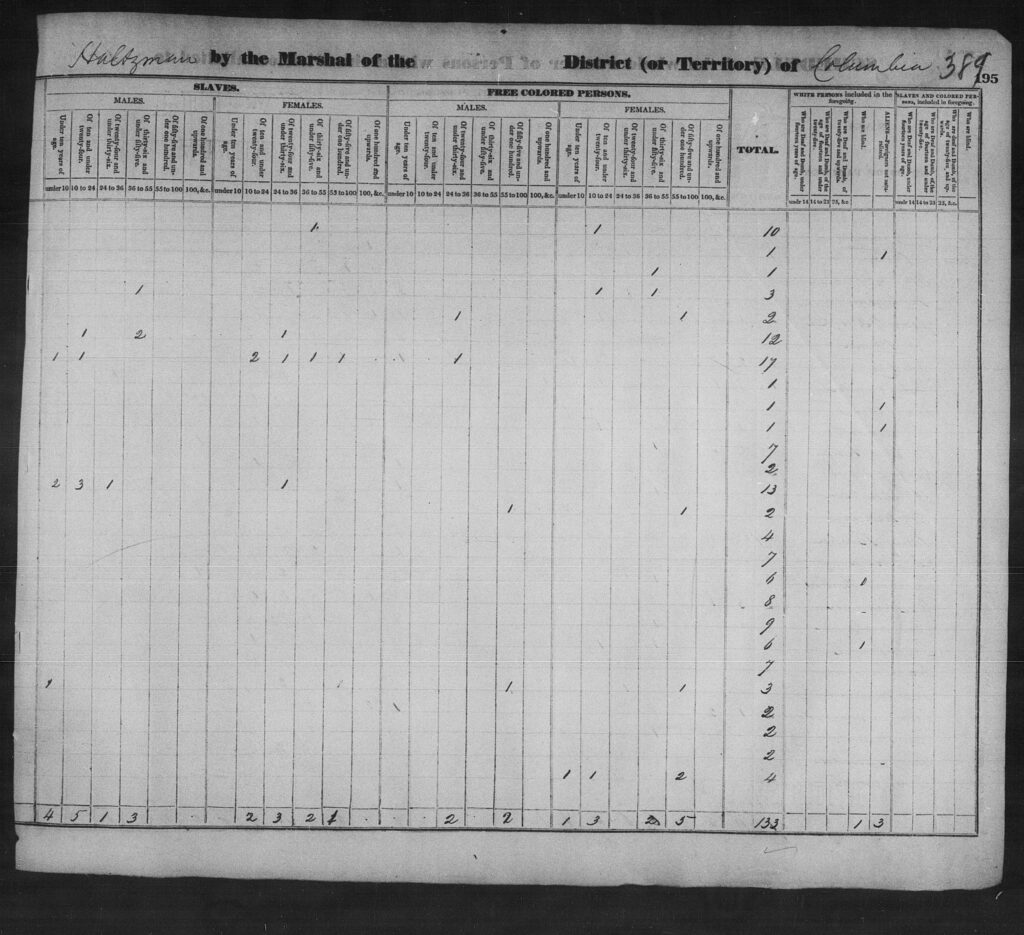
1830 Census, showing the total number of people listed at Samuel Whitall’s Georgetown property: nine white, seven enslaved, and one free Black.
In addition to enslaved individuals, the Whitalls utilized the labor of a number of free Black and white laborers to support their household. This includes at least five free Black laborers and two or more white laborers who appear to have been Irish immigrants. We only have the name of one free Black laborer, R.F. Beall, who was listed on the 1850 census alongside the other free members of the Whitall household.
Although Charles Carroll of Bellevue died in 1823, the Whittalls continued to rent the house from his descendants until 1841, when they purchased it from his estate. Upon Samuel’s death in 1855, ownership of the house transferred to his widow Lydia. She ran the property until her death in 1862, and is listed as head of household on the 1860 census. Also listed on the 1860 census is Grace Ducket, who had been enslaved at Bellevue by the Whitalls since 1826. The fact that she was listed by name on the census implies that the census taker assumed she was free, but in fact Grace would not be manumitted until April 1862, when Lydia freed her in her will, two weeks before slavery was outlawed in the District of Columbia. Upon her manumission, Grace went to live with her daughter, who had also been enslaved by the Whitalls, until she died in 1874 at the age of 83. She is buried in Mount Zion Cemetery, steps away from Dumbarton House, where her grave can be visited to this day.
Written by Curator of Archives and Collections, Isabella Kiedrowski
June 2026
Notes:
- At the time of the 1820 census. ↩︎
Bibliography:
Mould, David H., and Missy Loewe. Remembering Georgetown: A history of the Lost Port City. Charleston SC: History Press, 2009.
Peter, Grace Dunlop. A Portrait of Old Georgetown. Dietz Press, Richmond, 1951
Lesko, Kathleen Menzie, Valerie M. Dabb, and Carroll R. Gibbs. Black Georgetown Remembered: A History of Its Black Community from the Founding of the “Town of George” in 1715 to the Present Day. 30th Anniversary Edition. Georgetown University Press, 2021.
“Multiple Classified Advertisements.” National Intelligencer, February 14, 1815, Gale Primary Sources
“Multiple Classified Advertisements.” National Intelligencer, December 14, 1816, Gale Primary Sources
“Multiple Classified Advertisements,” National Intelligencer, June 1, 1816, Gale Primary Sources
“Multiple Classified Advertisements,” National Intelligencer, January 18, 1817, Gale Primary Sources
“Multiple Classified Advertisements.” National Intelligencer, March 3, 1817, Gale Primary Sources
Unrau, Harland D. “Historical Resource Study: Chesapeake & Ohio Canal” https://www.nps.gov/parkhistory/online_books/choh/unrau_hrs.pdf
Davies, William E. The Geology and Engineering Structures of the Chesapeake and Ohio Canal, An Engineering Geologist’s Descriptions and Drawings, 1999
Douglass, Frederick. Narrative of the Life of Frederick Douglass, An American Slave, Written by Himself (Boston: the Anti-Slavery Office, 1845)
“United States, Census, 1820,” database with images, FamilySearch (https://familysearch.org/ark:/61903/3:1:33S7-9YBM-R68?cc=1803955&wc=3L7F-Z5V%3A1586985202%2C1586984707%2C1586984818 : 16 July 2015), District of Columbia > Washington > Georgetown > image 1 of 42; citing NARA microfilm publication M33, (Washington D.C.: National Archives and Records Administration, n.d.).
“United States, Census,1830”, FamilySearch (https://www.familysearch.org/ark:/61903/1:1:XHGB-W8V : Sat Mar 09 23:01:27 UTC 2024), Entry for Saml Whitall, 1830.